
Software Localization
Software Localization Consistent product experience for global users
String extraction, UI adaptation, pseudo-localization and LQA so multilingual builds ship cleanly.
- Official Seal Code 3101150909750
- TAC Institutional Member
- ISO 17100 Certified Quality
- Strict Enterprise NDA
Trusted by Global Leaders in Advanced Industry & Life Sciences
Delivering enterprise localization for robotics, healthcare, clean energy, and tech multinationals
工业自动化
某欧洲工业自动化与机器人领军集团
新能源汽车
某全球新能源乘用车出海领军企业
医疗器械
某全球前十医疗科技与器械制造商
跨国制药
某全球跨国创新药与肿瘤制药巨头
能源电网
某特大型电力能源与变电成套工程集团
消费电子
某全球头部智能终端与操作系统研发商
汽车零部件
某全球汽车底盘与动力系统跨国集团
消费健康
某国际知名消费医疗与大健康跨国企业
能源管理
某全球能源管理与自动化低碳技术集团
跨境法务
某国际知名出海合规律所与涉外仲裁机构
临床研究
某国际临床试验机构 (CRO) 与生物样本中心
软件出海
某全球化企业级云协同与出海 SaaS 独角兽
工业自动化
某欧洲工业自动化与机器人领军集团
新能源汽车
某全球新能源乘用车出海领军企业
医疗器械
某全球前十医疗科技与器械制造商
跨国制药
某全球跨国创新药与肿瘤制药巨头
能源电网
某特大型电力能源与变电成套工程集团
消费电子
某全球头部智能终端与操作系统研发商
汽车零部件
某全球汽车底盘与动力系统跨国集团
消费健康
某国际知名消费医疗与大健康跨国企业
能源管理
某全球能源管理与自动化低碳技术集团
跨境法务
某国际知名出海合规律所与涉外仲裁机构
临床研究
某国际临床试验机构 (CRO) 与生物样本中心
软件出海
某全球化企业级云协同与出海 SaaS 独角兽
Software Localization Scope
Comprehensive software localization engineering from string parsing to in-build LQA.
UI String Translation
Specialized localization for desktop and cloud web interfaces covering menus, buttons, dialogs, tooltips, and system alerts. Utilizing vi…
Mobile UI Adaptation
Designed for compact mobile viewports across smartphones and tablets. We provide turnkey localization for native iOS (.strings, .stringsd…
Help & Release Notes
Dedicated to online customer help centers (Zendesk, Intercom, Notion), user manuals, and version update Release Notes for SaaS products a…
LQA Testing
Executed on live binary builds across physical machines and test environments by in-market QA linguists. We systematically audit text tru…
App Store Listings
Your listing is the primary touchpoint dictating whether international users install your mobile app. Conforming strictly to Apple App St…
CI/CD Integration
Ending the outdated waterfall bottleneck of 'holding releases for translation'. Integrating GitHub Actions, GitLab CI/CD, and modern TMS …
Why Linguist for software localization
Products feel natively built in each market—not just translated strings.
Engineering-ready
Familiar with i18n frameworks and resource formats to reduce dev rework.
Launch experience
Multi-region releases with timezone, compliance and store review copy.
Continuous updates
Incremental translation and TM reuse to control long-term cost.
Linguists + testers
Native translators and LQA testers for language and functional quality.
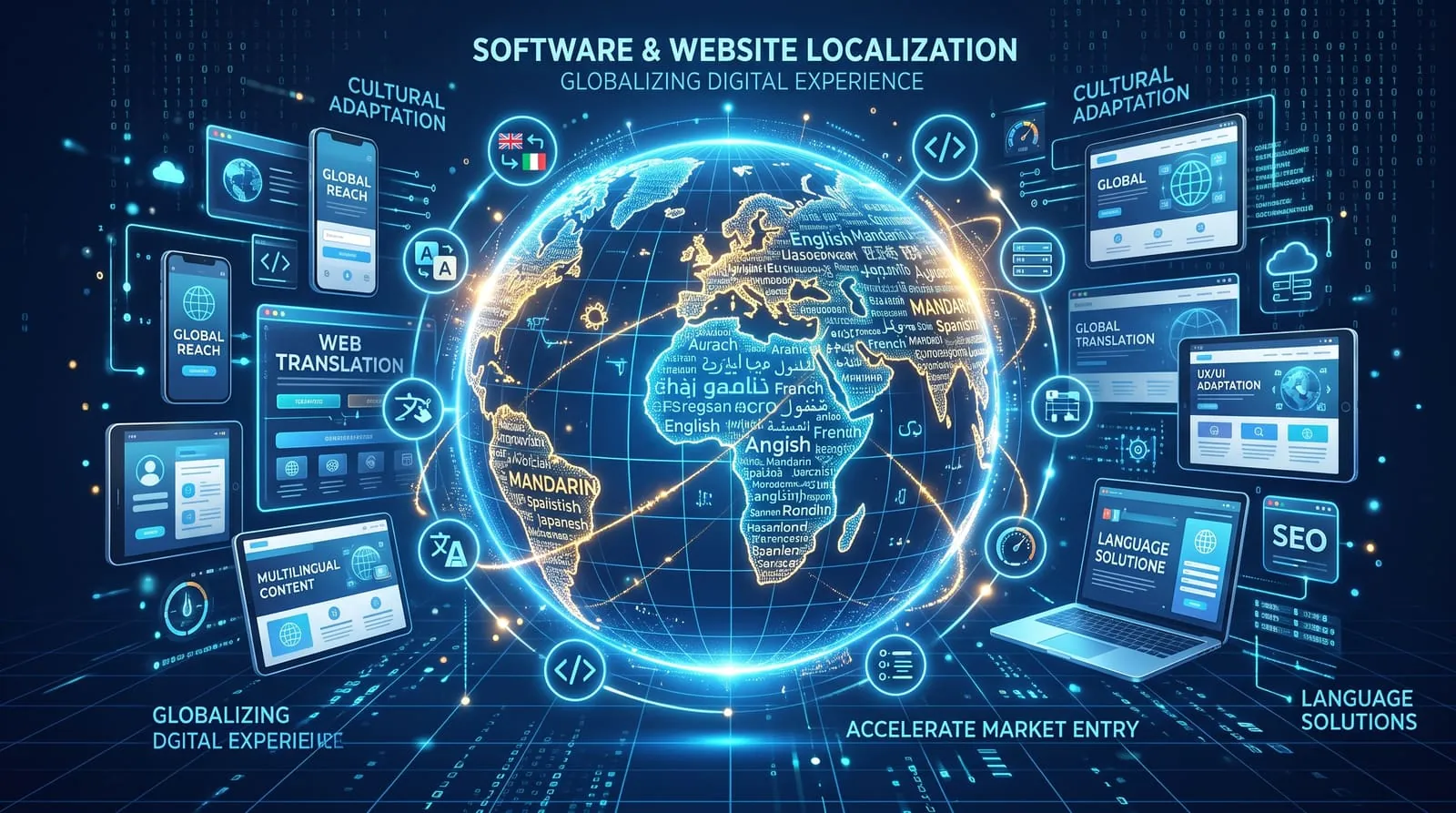
Resource formats
Compatible with common dev toolchains and sprint cadence.
Industries
B2B SaaS, consumer apps and embedded software experience.
Project Preparation
The following information helps accurately assess scope, timelines, and quotation.
Source Files
Provide software resource files (JSON, RESX, XML, PO, Strings, YAML, etc.).
Target Languages
Specify target locales and regional variants (e.g. en-US, es-ES, zh-TW).
Purpose & Audience
Clarify application context (Mobile App, Enterprise SaaS, Desktop) and user profile.
Terminology & References
Provide UI glossaries, variable syntax rules (%s, {count}), and screen mockups.
Format & Timeline
Confirm resource file formats, staging build testing schedules, and release deadlines.
Software Localization Engineering Workflow
Variable protection, pseudo-localization pre-flight, and live build LQA.
Deliverables
- Validated target resource files (JSON / RESX / PO / Strings)
- Automated placeholder & syntax QA verification report
- Linguistic Quality Assurance (LQA) bug log with screenshots
- Software UI terminology glossary and abbreviation guidelines
Prerequisites & Scope Notes
- Hardcoded Strings: Strings concatenated in code logic must be externalized into resource files
- Pluralization Syntax: ICU MessageFormat or plural forms require parser alignment
- LQA Test Environment: Staging builds, test accounts, and user journey scripts required for deep testing
- Hotkey Mapping: Keyboard accelerator key re-mapping rules to be agreed with dev lead
Software UI Resource Localization Sample
Demonstrating SaaS control panel JSON resource variable protection and length fitting.
{ "dashboard.nodes.alert": "Alert: {count} active server nodes exceeding memory threshold of {limit}%." }
{ "dashboard.nodes.alert": "警告:{count} 个活跃服务器节点的内存使用率已超出阈值 {limit}%。" }
| UI Key & Source String | Target Chinese Copy | Engineering Rule |
|---|---|---|
| memory threshold | Memory Utilization Threshold | Context Precision: Clarifies utilization threshold to avoid ambiguity |
| {count}, {limit} | {count}, {limit} | Variable Locking: Preserves placeholder tokens and syntax flawlessly |
| active server nodes | Active Server Nodes | Standard Cloud IT Term: Enforces platform-wide consistency |
Cloud Distributed Cluster Console UI Table
Service: Software Localization · Format: JSON Resource File
Variable Safety
Strict preservation of {count} and {limit} tokens to prevent runtime crash.
UI Pixel Fitting
Concise phrasing to prevent truncation within fixed-width dashboard panels.
Terminology Alignment
Synchronized with backend error codes and developer documentation.
Enterprise RESTful Translation API & CI/CD Pipeline
Seamlessly embed certified human-in-the-loop translation, TM governance, and terminology lookups into your GitHub Actions, CMS, and ERP systems.
⚡ 4-Step Continuous Localization Pipeline
Git Commit / CMS Webhook
Auto triggers on code push or CMS publish.
TM Vault & Terminology Match
Seamlessly leverages pre-approved glossaries.
ISO 17100 Dual Native Pass
In-country native experts review and approve.
Automated Callback & Release
Auto PR creation or instant API callback.
curl -X POST https://api.worldlingo.cn/v1/translate \
  -H "Authorization: Bearer wl_live_sec_89f02c4b" \
  -H "Content-Type: application/json" \
  -d '{
    "source_lang": "en",
    "target_langs": ["zh", "ja", "de"],
    "domain": "medical_iso13485",
    "quality_tier": "iso17100_native_review",
    "tm_vault_id": "tm_enterprise_sanofi_2026",
    "text": "The patient monitor must maintain continuous ECG telemetry during MRI scanning.",
    "callback_url": "https://client-corp.com/api/webhooks/translation-ready"
}'{
"status": "success",
"job_id": "job_wl_2026_98821a",
"domain": "medical_iso13485",
"lqa_score": 99.9,
"term_vault_matches": 3,
"translations": {
"zh": "在核磁共振 (MRI) 扫描期间,患者监护仪必须保持不间断的心电遥测 (ECG)。",
"ja": "MRIスキャン中、生体情報モニタは連続的な心電図(ECG)テレメトリを維持しなければならない。",
"de": "Der Patientenmonitor muss während der MRT-Untersuchung eine kontinuierliche EKG-Telemetrie aufrechterhalten."
}
}ISO 17100 6-Step Delivery Pipeline & SLA Timeline
Transparent milestone tracking from 24-hour rapid turnaround to enterprise continuous releases.
Term Extraction & Sign-off
Extract core glossary & align with client
Expert Team Translation
Modular parallel translation in TMS
Native In-Country Final Review
Full in-country native polishing
Print-grade DTP Layout
InDesign / CAD / Word 1:1 reproduction
Full MQM LQA Audit
Cross-check metrics & compliance
Certified Delivery & Warranty
Deliver all open files + 30-day warranty
Related resources
Explore related industry solutions, language pairs and case studies.
Related industries
- Software localizationEnd-to-end software and digital product localization—UI strings, help docs, store assets and CI/CD integration for SaaS, apps and games.
- Mobile app localizationiOS/Android UI, push copy, store assets and help docs—with LQA and truncation testing.
- SaaS localizationSaaS web consoles, email templates, help centers and marketing sites in multiple languages.
Related language pairs
- Chinese to English Software translationProfessional software chinese to english translation—Chinese to English translation with dedicated terminology glossaries, native dual review, ISO 17100 quality standards, and rapid delivery.
- Chinese to Japanese translationProfessional chinese to japanese translation—Chinese to Japanese translation with native linguists, terminology glossaries, ISO 17100 QA workflows, and reliable delivery for global businesses.
Case studies
- B2B SaaS Platform Multilingual Global RolloutLocalized web app, admin console, email templates and help center for a collaboration SaaS across EMEA and APAC. Five-language simultaneous launch; trial conversion up 22%
- Global Tech Unicorn Mobile App Localization & 12-Market LaunchEnd-to-end mobile app localization covering UI string extraction, layout adaptation, multi-region ASO, and real-device LQA for 12 global markets. Simultaneous 12-country release on App Store & Google Play with a sustained 4.8-star rating
Frequently asked questions
Common questions on pricing, turnaround, confidentiality and file formats—contact us for anything else.
Ready to Start Your Project?
Submit your requirements and files. Our consultant will provide a transparent quote and timeline within 24 hours.
What is included in software localization?
How do you control cost on version updates?
How much does Software Localization cost?
What factors affect translation pricing?
How long does translation take?
Can you handle urgent projects?
Ready to Start Your Project?
Submit your requirements and files. Our consultant will provide a transparent quote and timeline within 24 hours.
Ready to discuss your Software Localization project?
Submit your materials to receive a tailored assessment and quotation.